Water Pollution Problems

-
Water pollution is arguably the most fundamental environmental issue in Malaysia, since the country’s pollution problems began with water pollution caused by the three traditional industries of tin mining, natural rubber, and palm oil, as mentioned above. The government’s environmental programs therefore give high priority to control of water pollution.
Malaysia does not publish exact values of river water quality measurements for individual monitoring sites. Instead, water quality status is published under three rankings (clean, slightly polluted, and polluted), using a Water Quality Index (WQI) based on six parameters: pH, dissolved oxygen (DO), biochemical oxygen demand (BOD), chemical oxygen demand (COD), ammonia nitrogen, and suspended solids (SS).
At present, water quality is monitored regularly at 908 sites on the 117 rivers in the country. Looking at results for 1997, which are the most recent published data, 24 of the 117 rivers were classified as clean, 68 as slightly polluted, and 25 as polluted. Comparing these results with the previous year (1996), the number of polluted rivers increased from 13 to 25, and the number of slightly polluted rivers increased from 61 to 68. Low rainfall, which resulted in reduced flow rates in the rivers, was cited as one of the reasons for the increased pollution. Sources of pollution identified as contributing to BOD loading include the agriculture-based industries (natural rubber and palm oil production, for instance), manufacturing industry, and livestock industry. Similarly, the livestock industry and domestic wastewater are cited as causes of worsening ammonia nitrogen pollution, and civil engineering works and land cultivation are blamed for the deterioration in SS status.
Overall trends, however, if weather conditions and other such factors are excluded, show an improvement in river water quality brought about by Malaysia’s adoption of wastewater regulations and development of sewerage systems.
In addition, the 1997 results identify a total of 4,932 factories as sources of river water pollution. By industry type, the polluters included 966 food and beverage manufacturing factories (20%), 559 paper factories (11%), and 419 electrical and electronics plants (8%). The breakdown by state shows that Selangor had the highest number of industrial sources of pollution (1,668 factories), followed by Johor (945) and Negeri Sembilan (371). In terms of individual rivers, the basin of the Klang River which flows through Selangor had the highest number of industrial pollution sources.
Rivers in Malaysia generally appear to have high organic pollution loads and high SS concentrations. However, because water pollution status is published as an index (WQI), we were unable to obtain accurate information about concentrations of river pollutants over recent years for this research. Nor could we get a precise picture of the severity of river pollution in Malaysia.

In moves to solve these water pollution problems, Malaysia is putting sewerage services in place to deal with household wastewater which is a leading source of pollution. Unlike sewerage systems in Japan, the projected wastewater treatment systems will handle household wastewater only. In 1993, Malaysia passed the Sewerage Service Act, paving the way for privatizing the sewerage systems. The task of privatization was undertaken by Indah Water Konsortium Sdn. Bhd., which aims to deliver services to 79 percent of the population within the year 2000.
In regard to marine pollution, 794 samples were collected and analyzed from 226 locations in 1997. Of these, 87 monitored locations, or 34 percent of the total, were found to have contaminant levels exceeding the Proposed Marine Interim Standards. Oil and grease exceeded the limit (0 mg/l), as did total suspended solids (50 mg/l), and coliform bacteria (100 MPN/100ml). Detected copper levels were above the Proposed Marine Interim Standard (0.1 mg/l) in Sarawak, and mercury.
In 1996 the Malaysia government began monitoring groundwater in the Malay Peninsula with the aim of preventing possible contamination. No contamination has been detected to date and arsenic exceeded the limits (0.001 mg/l and 0. 1 mg/l, respectively) in Negeri Sembilan.
Air Pollution Problems
Air pollution in Malaysia falls into three main categories: air pollution due to exhaust gas from mobile emission sources such as motor vehicles, principally in urban areas; haze caused by the weather and by forest fires in neighboring Indonesia; and pollution caused by industrial activities.

Of these three problems, air pollution from mobile emission sources is of greatest concern. In 1997, there were roughly 8.5 million registered motor vehicles in Malaysia, climbing at the rate of 10 percent or more every year. According to 1997 figures, the estimated quantities of air pollutants released by these vehicles were 1.9 million tons of carbon monoxide (CO), 224,000 tons of nitrogen oxides (NOx), 101,000 tons of hydrocarbons (HC), 36,000 tons of sulfur dioxide (SO2) and 16,000 tons of particulate matter. Mean values for the years 1993 to 1997 show that the amount of air pollutants from mobile emission sources accounts for 81 percent of all air pollution occurring in Malaysia. The problem will clearly become even more critical as the number of motor vehicles keeps on increasing.
As a result of these forms of pollution, Kuala Lumpur and its outskirts, which have heavy motor vehicle traffic, are exposed to high levels of NOx and SO2, and of particulate matter measured as PM10. Air pollution due to particulate matter, although still below the environmental standard at present, is growing more severe as time goes on.
Another problem is black smoke from diesel motor vehicles, the subject of numerous complaints from the public. In response, the government has launched a campaign to crack down on vehicles that violate the regulations. In regard to lead pollution, the government in 1991 introduced incentives to use unleaded gasoline, and since 1996 it has been obligatory for gasoline-fueled vehicles to have catalytic converters. These policies have been successful in reducing the level of lead in the atmosphere year by year.

Haze is another major problem in Malaysia. There were minor haze incidents in 1993 and 1994, years that recorded low rainfall, but haze on an unprecedented scale occurred from the summer of 1997 due to the huge forest fires that blazed in Sumatra and Kalimantan in Indonesia. The haze that year continued for five months, from mid-July to November. In late September, when the haze was most severe, air pollution readings in Sarawak exceeded the “hazardous” level of 500 on the Air Pollutant Index (API). As well as affecting health and causing an increase in respiratory complaints, the 1997 haze incident had major economic costs, impacting on transportation services, tourism, and the fishing industry among others. The disaster prompted the government to subsequently ban all open burning within Malaysia.
Air pollution caused by industrial activities is still low in Malaysia. Including both industrial fuels and industrial processes, the industrial sector contributes only 7 to 8 percent of total air pollution in the country. Except for special industries such as quarry and rubber production, industrial activities are not a major factor.
There are currently 29 air quality monitoring stations in Malaysia, continuously taking air pollution readings. As with water quality, the results are published according to an API. The API consists of five parameters (PM10, CO, NO, SO2, and ozone (O3)), and readings are classified in five rankings(good, moderate, unhealthy, very unhealthy and hazardous).
As measured by the API, air pollution nationally was at good to moderate levels in 1997, except in September when particulate matter was at high concentrations because of the haze, and air pollution was not a particular problem. Readings for the five substances used as parameters were also below the air quality standards, except for PM10 levels around September.
Waste Problems
Industrial waste is the greatest environmental dilemma affecting Japanese companies and all those conducting industrial activities in Malaysia. Until 1997 Malaysia still had no approved final disposal facilities, as prescribed in the legislation, for dealing with the scheduled wastes defined in the set of regulations and orders enacted in 1989. For nearly a decade, Japanese companies had to go to great lengths, storing scheduled wastes on-site, for example, if they wanted to deal with their wastes in compliance with the law.

Scheduled wastes cover a wide range of industrial wastes. They include not only hazardous and dangerous substances but also sludge generated by general manufacturing processes and wastewater treatment. The volume of scheduled wastes generated in Malaysia is increasing every year as industrial activity booms. According to the Department of Environment (DOE) statistics, the volume rose from about 420,000 tons in 1994 to 630,000 tons in 1996. In 1997, the volume of scheduled wastes fell to280,000 tons, partly because of changes in statistical techniques, but also because of the advent of the currency and economic crisis. The volume is predicted to rise again, however, when the economy rebounds. According to 1997 figures, the chemical, textile, and metal working industries generated a large amount of scheduled wastes, and various types of sludge and acid wastes accounted for more than half of the generated wastes.
However, because Malaysia still has only one final disposal facility and the disposal costs are relatively high even in comparison with Japan, illegal dumping is an ongoing problem and incidents of illegal dumping make major news stories from time to time in the newspapers and other media.
Scheduled wastes are given high priority in Malaysia’s environmental programs and penalties for illegal dumping are quite strictly enforced. There are frequent court cases about illegal dumping, and the waste disposal issue will likely be a headache in future years for Japanese companies and for other foreign companies operating in Malaysia.
In the past, foreign companies and other enterprises that were unable to store their scheduled waste onsite sometime exported them for resources recovery or reuse. However, in 1993 Malaysia ratified the Basel Convention on the Control of Transboundary Movement of Hazardous Wastes, and since then the
government has taken an increasingly strict approach to the export of scheduled wastes. In 1997 there were 58 applications to export scheduled wastes, including 18 outstanding cases, but only 12 were approved within the year, and waste export is no longer allowed unless for resource recovery under the strictest criteria. In 1996 Malaysia drew up guidelines on transboundary waste movements with its nearest neighbor, Singapore, a country closely involved with Malaysia in regard to the flow of goods and materials.
Wastes other than scheduled wastes are treated and disposed of by private recycling and treatment companies under contract with the industrial or commercial concern that generated the waste. However, the wastes that remain after salvaging materials of value – plastics, cardboard and metal, for example – mostly goes to landfills.

Local authorities used to be responsible for collecting, treating, and disposing of municipal wastes, but in recent years there have been concerted moves to transfer the operation to privatized companies in which the state government and private sector both have a stake. The country has been divided into four regions, each with a private waste management operator already established. Municipal wastes are disposed of by landfill without any intermediate treatment, and most of the landfill is carried out by open dumping.

Wednesday, 2 December 2015


Cultural and social factors that affect development
DiscriminationSometimes there are social or cultural factors that hold back poor countries. Discrimination is one of these. If there are certain people groups that are discriminated against, the country’s overall productivity can suffer. This may be a tribe, a caste, a racial category or minority language group. I have already mentioned Cameroon, which has both French speaking and English speaking regions. All the infrastructure happens in the French speaking part. French speakers in Canada complain of the opposite. Welsh speakers in Britain, or Catalans in Spain, have historically faced similar problems. Racial discrimination may be an issue, excluding certain groups from economic activity, either deliberately or not. Racial minorities regularly have poorer exam results and economic prospects than the majority. More serious forms of exclusion would be apartheid South Africa, or the Asian communities driven out of Uganda under Idi Amin, which was disastrous for Uganda’s economy.

Another division may be the role of women. Jeffrey Sachs talks about this in The End of Poverty ‘Cultural or religious norms may block the role of women… leaving half the population without economic or political rights and without education, thereby undermining half of the population in its contribution to overall development.’ If you don’t believe that women should work, you have effectively halved the earning potential of your country.
Population
Closely linked to this is the population issue. If women see staying at home and bringing up children as their chief role, they will have more children than those who work. There is nothing wrong with having lots of children, as long as you can provide for them. Jeffrey Sachs again: ‘With fewer children, a poor household can invest more in the health and education of each child, thereby equipping the next generation with the health, nutrition, and education that can lift living standards in future years.’

As Paul has talked about here before, world population has exploded. What is interesting is that the countries where this has happened are often those where women do not play a role in business or society. When women are educated and given a choice, some will stay at home and look after children, and others will pursue careers or start small businesses.
This is an important factor, as some countries have seen their population double or triple without their economies keeping pace. That leaves more mouths to feed, and just not enough to go around.
Culture
I’ve already mentioned the role of women, but culture can have hidden effects in business, trade and development. China may be a major power now, but it was the world’s most developed country in the middle ages, and stagnated, or even went backwards, for centuries. Part of this was cultural, a pride and sense of self-sufficiency that led to a closing of China’s borders. ‘China seems to have long been stationary’, Adam Smith wrote in 1776, in his Wealth of Nations. ‘A country which neglects or despises foreign commerce… cannot transact the same quantity of business which it might do with different laws and institutions.’ That’s changed, but nationalism, suspicion, or radical philosophy still has some countries closed down to outside involvement – communism in North Korea, or extremist Islam in Taliban Afghanistan, locking countries out of development.

This the far end of the spectrum, but culture works in subtler ways too. Some cultures believe in a greater good, in unity, in the rule of law. They are optimistic, hopeful, ambitious and ready to pull together. Others can be paranoid, fragmented, uncertain of their place in the modern world, angry, resistant to change. Rich countries can be overconfident and brash. Poor countries can see themselves as victims and become despondent. In his The Wealth and Poverty of Nations, economic historian David Landes says ‘If we learn anything from the history of economic development it is that culture makes all the difference.’
The limits of cultural interpretations
At the same time, cultural influences on development are notoriously hard to call from the outside. Hinduism was often cited as one of the reasons why India would never develop. Because everyone accepts their place in the world, it was assumed that Hindus would lack the ambition required to innovate and do business on an international stage. The recent growth in India’s economy proves that wrong quite spectacularly. Korean economist Ja-Hoon Chang quotes a 1911 travel book that describes Koreans as “sullen, lazy and religion less savages”, something that hardly holds true today. So did Korean culture change, or was the writer simply being superior?

We understand each other better than ever in our globalized world, but our language and traditions are still full of little prejudices that imply we are better than others, and that our neighbors are lazy and dirty and uncouth. I love the fact that not turning up for work is called ‘taking French leave’ in England, and ‘filez a l’Anglaise’ (or ‘doing an English’) in France. A Malagasy friend once joked that in Madagascar, every tribe believes that every other tribe eats cats. In short, culture no doubt plays a role in development, but we have to watch our own biases as we seek to understand why some countries succeed and others fail.
Tuesday, 1 December 2015
BABY-DUMPING ISSUE IN MALAYSIA
 Our country unmarried teenage
pregnancies has a chronic increase recently and
many young mums to be are estranged from
their families. As a muslim, we believe that child is a priceless gift
from Allah
SWT. However, lately the baby dumping cases happen almost every day.
Teenage parents give birth in a motel room and leave the child for dead
in a garbage. A girl gives birth in a school bathroom at night and
throws the baby
into the garbage. These stories relate to one of the most frightening
realities
of our culture today.
Our country unmarried teenage
pregnancies has a chronic increase recently and
many young mums to be are estranged from
their families. As a muslim, we believe that child is a priceless gift
from Allah
SWT. However, lately the baby dumping cases happen almost every day.
Teenage parents give birth in a motel room and leave the child for dead
in a garbage. A girl gives birth in a school bathroom at night and
throws the baby
into the garbage. These stories relate to one of the most frightening
realities
of our culture today.
How could this problem keep on happening? There are
many factors that cause this problem continuously occurring in Malaysian
society. Lifestyle of teenagers itself, for example when they are in
campus or in college, the
teenagers are free act without parent’s control. Some of them date and
try to
do something as couple. Sometimes they can make ‘‘something’’ out of
their
mind in which turning out to be out of their own expectation. Just start
with going out
for a dinner by riding the same vehicle together. If it is just for a
dinner,
then there is no problem. But if the dinner’s over and they’re still
together alone
in a car, then that is not right and ‘something’ bad can happen.
Perhaps that ‘’something’’ can be call it as sumbang mahram or zina in
Malay Language.
 |
| unsafe relationship could lead to unhealthy sex and the birth of baby before marriage. (Picture credit to news.asiaone.com) |
Every boy and girl has to know their
limitation of relationship. Parents should play their role in order to
prevent their own children from social problem. Parents should give
awareness about the dangerous
of baby dumping, introduce true Islam to the children especially to the
muslim
youth about halal and haram in opposite sex relationship.

Besides
that, by celebrating New Year’s Day and Valentine’s Day are also the factors of
baby dumping to happen. Most of the teenagers were easily cajoled into having
unmarried sex because they were naïve. During the New Year celebration and
Valentine Day celebration, many of teenage girls cheated by their boyfriends,
saying that they had to prove their love to their boyfriends by having sex
together. As a naïve teenager of course they will do and give everything for
their sweetheart without thinking about the sins and problem that might be happening
in the future.
Once the teenagers find themselves pregnant, they are about to fend for themselves, and they became estranged from their family after they know about the pregnancy. Thus, causes the young mums to be scared in dealing with feelings of fear, anger, disappointment and confusion, therefore they take the easiest and fastest way out by abandon or worse, by killing the baby (abortion, baby dumping).
On top of that, the widespread access to porn and
weakened family ties also has a link to the baby dumping. Effects from globalization
nowadays, youth today can easily have access to pornography online, even
through their mobile phones. The parents should play a role in controlling their
children’s activities inside and outside of the house. They should know their
children going out with whom and where did they go in order to avoid their children
from unhealthy activities and involve with social problem.Once the teenagers find themselves pregnant, they are about to fend for themselves, and they became estranged from their family after they know about the pregnancy. Thus, causes the young mums to be scared in dealing with feelings of fear, anger, disappointment and confusion, therefore they take the easiest and fastest way out by abandon or worse, by killing the baby (abortion, baby dumping).
 |
| Act of baby dumping should be stopped to avoid the lost of innocent new life. (Photo credits to mahaguru58.blogspot.com) |
The
social stigma attached to premarital pregnancies forces them to conceal and
abandon the babies, leading to horrifying deaths. As long as society refuses to
accept reality, baby dumping will continue to be a social whip in our country.
Parents have to be more open and supportive to help their girls manage their
pregnancies. This should not be viewed as condoning premarital sex. There is
indeed a need for change of mindset and the way of managing something in which had
been done, in this case the premarital sex.
Poverty
is also another factor that causes child dumping. Poor social welfare systems,
not capable to pay the medical bills and not financially capable of taking care
of a child are more likely the factors to dump the baby. Political conditions,
such as difficulty in adoption proceedings, may also contribute to child
dumping. “Having one’s first child is the most stressful experience someone can
go through. Young mothers can be vulnerable, especially if they are alone and
do not have the experience or social support to cope.”-Dr Boulton, a child
psychologist at the University of Keele.
Effects
of baby dumping are on individuals itself, the baby and society. On infants, it
will give a problem cause contempt regarded by society as adults, problems if
you want to marry because there is no guardian and it will difficult for
schools because there is no birth registration. It may effects on society too.
The abortion will be mimicked by others. On individuals, it can cause
psychological effects on the mental and emotions after marriage, such as
depression, especially when age is often thought of as the content is never
removed.
The
government, families, and communities should take the role to overcome the baby
dumping problem. There are no easy solutions, and so we are required to expand
our efforts to reach prevention at a standstill. Steps must be taken to prevent
unwanted pregnancies.
Sexuality
education, for example the Ministry of Education agreed to implement a sex
education. Recommends communities provide comprehensive sexuality education to
youths and families. Education should strive to increase communication among youth,
families, and communities thus, can minimize the shame on unwanted pregnancy
and make young people want to take advantage off supports and services in their
families and communities.
Campaign
towards the regions and categories of population with focus on the prevention
programs increased risks of dumping. For example in 2001, Malaysia launched the
“Say Yes for Children” campaign to create awareness on the protection of
children. The campaign was aimed at creating a conducive and enabling
environment for children to grow up. It was built on 10 imperative actions and
responsibilities, which are:
 |
| Say Yes for Children Campaign. (credit to www.sgm.org.my) |
“To love
children is to respect them. The children in turn will grow up and respect
their parents in appreciation for what has been done”(Tan Sri Lee Lam Thye,
Vice chairman Malaysia Crime Prevention Foundation, 2012). Therefore for the
parents to be respect by their children parents should acquire parenting skills
to bring up their children. They should make every possible effort to spend
quality time with their children, thus can prevent from social problem among
teenagers when the children growing up.
On top
of that, communities and government should provide shelters to unwanted
pregnancies women or teenagers in order to help them, give them a second chance
at life and give their babies the right to live. For instance in Gombak, there
is a house for pregnant teenagers who have nowhere else to turn called Kem Asas
Pembangunan Integriti Wanita dan Modal Insan (KEWAJA). When a teenager gets
pregnant, she starts thinking of the worst case scenario. She starts wondering
‘who wants me?’, ‘how do I keep this a secret?’. Therefore KEWAJA is here with
role to ensure adolescent girl and woman which involved in assignable guidance
and life guidance that they practise good values in their life, have personal
strength, mind and faith to survive and can monitor activity during and their
direction of life inside societal community (Yahya Yusof, KEWAJA
DIRECTOR,2011).
The
thing that more important is KEWAJA can save them from act that risky such as
abortion and perhaps also dump or leave the child after born.
In
Conclusion, we can’t point our finger to anyone we want, but this time we have
to examine the best solution to reducing this social problem together.
ISSUE VAPE

The Sultan of Johor has ordered a ban on vaping in the state and His
Royal Highness has given the owners of vape outlets a month’s deadline
to close down.
“This is a question of health and its effects on young people. It has nothing to do with businesses and for sure, it has nothing to do with race.
“I am greatly disappointed that some people are bringing up racial threats and political threats,” he said in an interview.
Sultan Ibrahim Ibni Almarhum Sultan Iskandar said the state had the right to invoke bylaws under the local government laws to shut down vape outlets.
The Sultan ordered the state executive council to meet next week to hasten the process.
He said politicians should also stop pandering to businessmen in the vape industry.
“Why are these politicians giving in to these threats? I want to know if these businessmen would allow their children to vape if it is so safe and healthy as they claim.
“Do you want to see your children puffing away?
“It is a new business. What kind of businesses were they doing before this? Go back to your previous work,” he said.
Earlier this month, Rural and Regional Development Minister Datuk Seri Ismail Sabri Yaakob said the Health Ministry’s enforcement against the sales of vapes containing nicotine would kill the Malay-dominated industry.
The minister made the comment after several bumiputra groups lodged a police report warning that the crackdown on vape could cost Barisan Nasional more than a million votes in the next general election.
The Johor Ruler said there would be long-term health effects of vaping and the medical cost, borne by taxpayers, would be staggering.
He said the ban in the state would cover all sales of vape products.
“It is also very clear, under the laws, that these vape outlets cannot sell nicotine, so why are we expected to close an eye to such disregard of the law?
“If it is not allowed, then it is not allowed. It is that simple,” he said.
“If we allow this to continue, we will be seeing a whole new form of addiction among our youth,” he said.

The Sultan warned that those who flouted the law after Jan 1 would face the consequences.
Health experts have said that there has not been any scientific evidence to prove that e-cigarettes would help smokers with addiction.
They said it would not help smokers to quit but start a new form of addiction instead.
Friday, 27 November 2015
Ringgit leads the way in Asian currency gains
Malaysia's ringgit climbed the most in a month and led gains in Asia as demand for the US dollar waned after the Federal Reserve provided a clearer picture on the timing of its interest-rate increase.The Fed's October minutes issued this week gave the strongest signal yet that the central bank will raise rates next month, with the wording for a gradual pace of future tightening supporting demand for emerging-market assets.
Brent crude stabilized after falling to a two-month low, helping boost sentiment for the ringgit.

"For the ringgit in particular, as an underperformer this year, it is a bigger beneficiary of reduced near-term pressure from the Fed and China factors," said Mr Dushyant Padmanabhan, a strategist with Nomura Holdings in Singapore.

The ringgit also jumped 1.4 per cent against the Singapore dollar, trading at 3.0250 per Singapore dollar in early afternoon from its close of 3.0693 on Thursday.
At its lowest trading close this year, the ringgit fell to 3.1351 against the Singapore dollar on Sept 30.
The ringgit may also have received a fillip from news that 1Malaysia Development Ber had is nearing an agreement to sell control of its power business to a Chinese-led group.
Indonesia's rupiah strengthened 0.9 per cent to 13,658 and Thailand's baht climbed 0.4 per cent to 35.747.
Mr Michael Every, head of financial markets research at Rabobank Group in Hong Kong, said that despite the recovery, the ringgit will likely resume its weakening trend now that markets have priced in Fed tightening, as the focus shifts back to the factors weighing on Malaysia's outlook - general US dollar strength, softness in commodities and potential declines in the Chinese currency.
A report in The Edge newspaper on Thursday cited Prime Minister Najib Razak as saying state-linked companies will repatriate RM627 million before year end as a means to boost the economy through domestic investment.

Malaysian consumer prices rose 2.5 per cent last month from a year earlier, the least in four months and matching the median forecast in a Bloomberg survey, according to a government report yesterday.

The central bank yesterday said that foreign exchange reserves, as of Nov 13, were US$93.9 billion (S$132.7 billion), slightly lower than the US$94 billion it reported on Oct 30. The reserves have dropped 19 per cent this year.
With fires wreaking havoc across Indonesia, Malaysian state targets greener palm oil
With devastating fires in Indonesia providing a backdrop for the destruction wrought by unrestrained plantation development, the Malaysian Borneo state of Sabah on Wednesday announced it is pressing forward with a plan to certify 100 percent of its palm oil production under criteria set by the Roundtable on Sustainable Palm Oil (RSPO) by 2025. The initiative aims to differentiate Sabah’s palm oil from other producers, while addressing environmental problems and boosting productivity of existing plantations as part of a broader push to shift toward a more sustainable and diversified economy.
According to a declaration issued by the Sabah Forestry Department, the Sabah state government will provide technical assistance to implement the program, including group certification to small holders at no cost. Larger companies operating in concessions managed by the Forestry Department have already been given deadlines to get RSPO certification, which requires producers to adopt production safeguards that reduce environmental and social impacts of cultivation and production.

“In time to come, with increasing expansion of oil palm plantations in other countries with suitable land to spare, Sabah’s share of the world market will shrink. Further to that, on costs alone, Sabah might not be able to compete and it is unlikely that Sabah will be in a position to expand its land area for planting further, due to the scarcity of lands and the marginal quality of whatever land is still available,” said the declaration. “Hence, to remain competitive with its CPO and its oil palm products salable economically, Sabah has to upgrade its position by competing on the basis of governance and not size, which it is unable to do.”
“Certified Sustainable Palm Oil as a brand for Sabah’s oil palm, shall elevate its position as a producer of responsible oil palm. This is what will keep us competitive,” the declaration continued. “The current forest fires, allegedly caused by bad oil palm development practices, must never be associated with Sabah’s oil palm.”
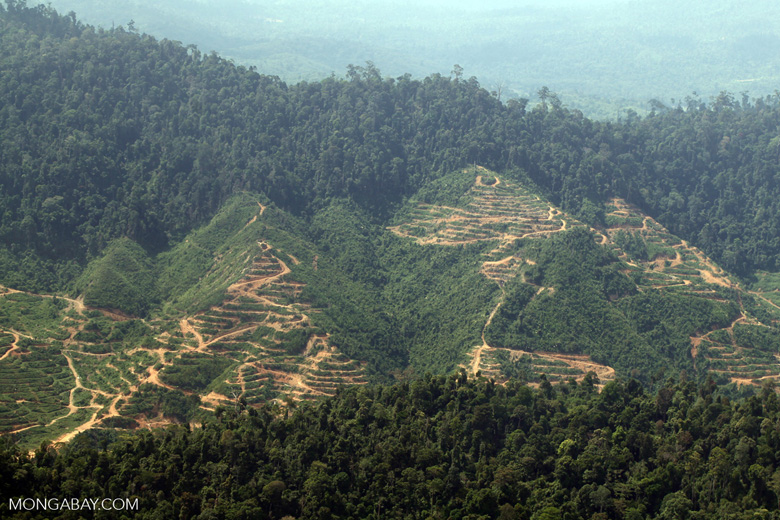
The certification program is a central component of Forever Sabah, a multi-stakeholder initiative that endeavors to transform Sabah’s economy.
“In Forever Sabah, we support a circular economy that respects the interconnectedness of life and we see this coming to fruition in future for the palm oil sector with Sabah’s commitment on certification,” said Forever Sabah director Cynthia Ong in a statement. “The jurisdictional level program is one that will put us on the right track to collectively support livelihoods and protect the environment. This jurisdictional approach could guarantee Sabah a key place in global markets that, even before the haze, do not accept business as usual in the palm oil sector.”
“The jurisdictional level CSPO initiative will be supported with precision and scientific agricultural practices to ensure yield can be increased with the same amount of land,” Ong continued. “This includes guidance on conserving insect population for pollination, recycling Palm Oil Mill Effluent (POME) as fertilizer, replanting with high-yield and genetically resilient plantlets, and community workshops to share latest best practices.”
Forever Sabah envisions going well beyond the palm oil sector, including establishing wildlife corridors, restoring forests degraded by logging, and setting up new protected areas. The initiative includes programs to foster polyculture and agroforestry, community-based ecotourism, and more responsible stewardship of marine resources.

Palm oil
Due to its high yield which makes it a cheap source of vegetable oil, palm oil is widely used as a cooking oil, a fat in processed foods like cookies and crackers, and an ingredient in cosmetics and cleaning products.
The world produced 54.3 million metric tons of palm oil in 2013. Indonesia accounted for roughly half of that production, while Malaysia came in about 35 percent.
 Human-wildlife
conflicts could potentially be reduced with the introduction of fully
certified palm oil for Sabah. Photo shows an elephant
Human-wildlife
conflicts could potentially be reduced with the introduction of fully
certified palm oil for Sabah. Photo shows an elephant
Monday, 23 November 2015
ASEAN should aim to be haze free by 2018
Malaysia hopes ASEAN should aim to
be a haze free region by 2018, said Natural Resources and Environment Minister
Datuk Seri Dr Wan Junaidi Tuanku Jaafar said here today.
He said he had attended the 11th
Conference of Parties (COP) to the ASEAN Agreement on Transboundary Haze
Pollution held in Hanoi, Vietnam on Thursday and Friday where the haze problem
was the main issue.
Although this is not an official
declaration yet Malaysia expresses the hope that the ASEAN region should aim to
be haze free by then,” he told the media after launching the state annual
Environmental Week celebration here today.
Wan Junaidi said ASEAN countries
like Myanmar, Cambodia and Northern Thailand also suffered from the haze
because of their forest fires. “But the severity is less because they do not
have huge areas of peat soil.
“Malaysia, Singapore and Indonesia
are badly affected when most of the 1.7 million hectares under peat in
Indonesia catches fires,” he said. On Indonesia ‘s commitment to fight future
forest fires, Wan Junaidi said he had met with his Indonesian counterpart, Siti
Nurbaya Bakar recently.
“Indonesia will send a delegation to study our peat
soil management system in which we have drains and dams to help moisturise such
soil.
“They also want to learn about our
tube well system while we have a very strong enforcement by the Department of
Environment which they can learn from,” he added On the haze,
Prime Minister Datuk
Seri Najib Razak, announcing this today, said both sides would appoint a
point person to ensure an immediate follow through
Read More : http://www.nst.com.my/news/2015/11/113339/pm-india-wants-msias-involvement-its-development
Read More : http://www.nst.com.my/news/2015/11/113339/pm-india-wants-msias-involvement-its-development
Prime Minister Datuk
Seri Najib Razak, announcing this today, said both sides would appoint a
point person to ensure an immediate follow through
Read More : http://www.nst.com.my/news/2015/11/113339/pm-india-wants-msias-involvement-its-development
Read More : http://www.nst.com.my/news/2015/11/113339/pm-india-wants-msias-involvement-its-development
Malaysia hopes ASEAN
should aim to be a haze free region by 2018, said Natural Resources and
Environment Minister Datuk Seri Dr Wan Junaidi Tuanku Jaafar said here
today.
He said he had attended the 11th Conference of Parties (COP) to the
ASEAN Agreement on Transboundary Haze Pollution held in Hanoi, Vietnam
on Thursday and Friday where the haze problem was the main issue.
“Although this is not an official declaration yet Malaysia expresses the
hope that the ASEAN region should aim to be haze free by then,” he told
the media after launching the state annual Environmental Week
celebration here today.
Wan Junaidi said ASEAN countries like Myanmar, Cambodia and Northern
Thailand also suffered from the haze because of their forest fires.
“But the severity is less because they do not have huge areas of peat
soil.
“Malaysia, Singapore and Indonesia are badly affected when most of the
1.7 million hectares under peat in Indonesia catches fires,” he said.
On Indonesia ‘s commitment to fight future forest fires, Wan Junaidi
said he had met with his Indonesian counterpart, Siti Nurbaya Bakar
recently.
“Indonesia will send a delegation to study our peat soil management
system in which we have drains and dams to help moisturise such soil.
“They also want to learn about our tube well system while we have a very
strong enforcement by the Department of Environment which they can
learn from,” he added
On the haze, Wan Junaidi said heavy rains, which occurred on October 17,
had helped to douse forest fires in Riau and Jampi and reduced the haze
problem considerably.
Read More : http://www.nst.com.my/news/2015/10/asean-should-aim-be-haze-free-2018-wan-junaidi
Read More : http://www.nst.com.my/news/2015/10/asean-should-aim-be-haze-free-2018-wan-junaidi
Prime Minister Datuk
Seri Najib Razak, announcing this today, said both sides would appoint a
point person to ensure an immediate follow through
Read More : http://www.nst.com.my/news/2015/11/113339/pm-india-wants-msias-involvement-its-development
Read More : http://www.nst.com.my/news/2015/11/113339/pm-india-wants-msias-involvement-its-development
PUTRAJAYA: India has
indicated its interest for a government-to-government cooperation in the
construction of a new convention centre in New Delhi.
Prime Minister Datuk Seri Najib Razak, announcing this today, said both
sides would appoint a point person to ensure an immediate follow
through.
"Indian Prime Minister Narendra Modi is a man of action and he wants
things to be done fast," Najib told reporters in a joint press
conference today.
A general view of a meeting between Malaysian delegates led by Prime
Minister Datuk Seri Najib Razak and Indian delegates led by India's
Prime Minister Narendra Modi at Putra Perdana in Putrajaya. Pix by
Aizuddin Saad
India also called on Malaysia to recognise the former's degrees in
Information Technology and engineering, he said, adding that the Higher
Education Ministry and Malaysia Quality Accreditation would act
immediately on this.
Najib said his Indian counterpart had presented to Malaysia "a lot of
exciting possibilities" for local companies and corporations to explore
in India.
"Modi has big plans to develop India in the construction of new
infrastructure including in railway development, highway development,
digital India, smart cities, solar energy and renewable energy."
Modi said India recognised Malaysia's ability in infrastructure
development.
The Indian prime minister also said he was keen to raise India's
participation in Malaysia's economy.
He added there were various areas that the two nations could explore
together including in defence and cyber-security.
Earlier, Malaysia and India signed three memorandum of understanding
(MoU) in performance management, project delivery and monitoring related
to government programmes and delivery; cultural exchange programme and
cyber security.
Read More : http://www.nst.com.my/news/2015/11/113339/pm-india-wants-msias-involvement-its-development
Read More : http://www.nst.com.my/news/2015/11/113339/pm-india-wants-msias-involvement-its-development
PUTRAJAYA: India has
indicated its interest for a government-to-government cooperation in the
construction of a new convention centre in New Delhi.
Prime Minister Datuk Seri Najib Razak, announcing this today, said both
sides would appoint a point person to ensure an immediate follow
through.
"Indian Prime Minister Narendra Modi is a man of action and he wants
things to be done fast," Najib told reporters in a joint press
conference today.
A general view of a meeting between Malaysian delegates led by Prime
Minister Datuk Seri Najib Razak and Indian delegates led by India's
Prime Minister Narendra Modi at Putra Perdana in Putrajaya. Pix by
Aizuddin Saad
India also called on Malaysia to recognise the former's degrees in
Information Technology and engineering, he said, adding that the Higher
Education Ministry and Malaysia Quality Accreditation would act
immediately on this.
Najib said his Indian counterpart had presented to Malaysia "a lot of
exciting possibilities" for local companies and corporations to explore
in India.
"Modi has big plans to develop India in the construction of new
infrastructure including in railway development, highway development,
digital India, smart cities, solar energy and renewable energy."
Modi said India recognised Malaysia's ability in infrastructure
development.
The Indian prime minister also said he was keen to raise India's
participation in Malaysia's economy.
He added there were various areas that the two nations could explore
together including in defence and cyber-security.
Earlier, Malaysia and India signed three memorandum of understanding
(MoU) in performance management, project delivery and monitoring related
to government programmes and delivery; cultural exchange programme and
cyber security.
Read More : http://www.nst.com.my/news/2015/11/113339/pm-india-wants-msias-involvement-its-development
Read More : http://www.nst.com.my/news/2015/11/113339/pm-india-wants-msias-involvement-its-development
Saturday, 21 November 2015
ISSUE GST
Goods and Services Tax or GST is a consumption tax based on
value-added concept. Unlike the present sales tax or service tax which is a
single stage tax, GST is a multi-stage tax. Payment of tax is made in stages by
intermediaries in the production and distribution process. The tax itself is
not a cost to the intermediaries since they are able to claim back GST incurred
on their business inputs. GST is imposed on goods and services at every
production and distribution stage in the supply chain including importation of
goods and services.
GST is a tax charged on the supply (including sales) of
goods and services made in Malaysia and on the importation of goods and
services into Malaysia. Even though GST is charged on the sales price of the
goods or services, the amount to be remitted to the Government is only on the
value added to the goods or services at each level of the distribution/supply
chain.
The value added is the value that a producer (whether a manufacturer or
distributor, etc) adds to its raw material or purchases before selling the new
or improved product or service. To enable this, GST adopts a credit offset
mechanism whereby GST charged on the output of the business (for example, sale
of product manufactured or services supplied) is offset against the GST paid on
the goods or services acquired as inputs (for example, raw materials or
utilities to be used in manufacturing) by the business.
GST charged on output
is called output tax. Whereas, GST incurred on acquisition is called input tax.
This offsetting mechanism is to ensure GST paid by businesses is recoverable
and thus help to reduce the costs of doing business.
The Government had conducted social impact studies which
show that consumers will most likely bear some slight additional tax burden
depending on their consumption pattern and the rate of GST to be fixed. To ease
the increase in tax burden, tax and non-tax package may be given. However,
basic items such as rice, poultry, meat, vegetable, flour, cooking oil, sugar,
residential and agricultural properties, education and health services will not
be subjected to GST.
The first hurdle is that tax is not a popular
subject matter and generally nobody likes to be taxed or rather the word
"tax" is taboo to many. However, governments all over the world need
to impose tax in order to get the revenue to provide their citizens with their
social needs (infrastructure, health and education services), industrial growth
which results in employment opportunities, security, etc. People find it
difficult to accept the GST due to lack of knowledge on GST and how it benefits
them.
The second hurdle is the level of knowledge on
GST. It is not easy to educate consumers on GST as the moment you mentioned
that GST is a form of tax you will first be faced with a wall of resistance.
Thus, GST and its benefits have to be explained to them continuously in order
to avoid or eliminate whatever misconception or the wrong representation
provided to them regarding GST.
Towards this end, the Government has emphasized
that the racial have to understand GST before it is actually implemented.
Currently, people are also not aware that the GST will replace the current
sales tax and service tax. In fact, many people are not even aware that they
are paying sales tax and service tax on a lot of goods and services because of
its single stage nature.
Subscribe to:
Posts (Atom)