
With fires wreaking havoc across Indonesia, Malaysian state targets greener palm oil
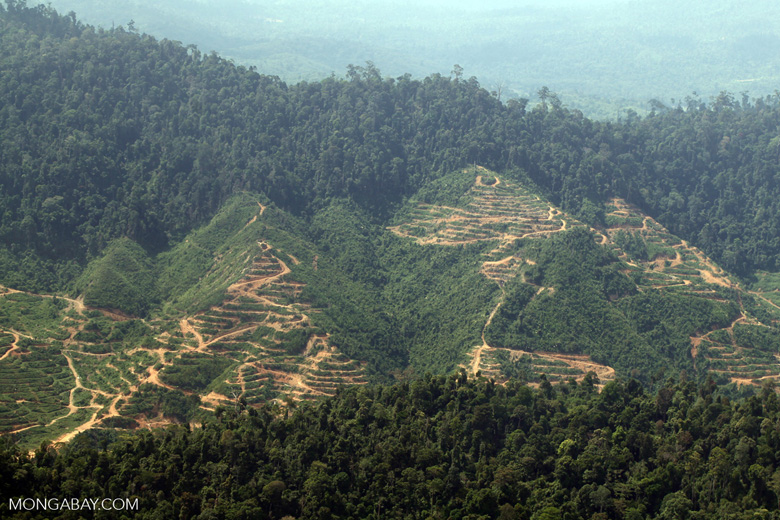
With devastating fires in Indonesia providing a backdrop for the destruction wrought by unrestrained plantation development, the Malaysian Borneo state of Sabah on Wednesday announced it is pressing forward with a plan to certify 100 percent of its palm oil production under criteria set by the Roundtable on Sustainable Palm Oil (RSPO) by 2025. The initiative aims to differentiate Sabah’s palm oil from other producers, while addressing environmental problems and boosting productivity of existing plantations as part of a broader push to shift toward a more sustainable and diversified economy.
According to a declaration issued by the Sabah Forestry Department, the Sabah state government will provide technical assistance to implement the program, including group certification to small holders at no cost. Larger companies operating in concessions managed by the Forestry Department have already been given deadlines to get RSPO certification, which requires producers to adopt production safeguards that reduce environmental and social impacts of cultivation and production.

“In time to come, with increasing expansion of oil palm plantations in other countries with suitable land to spare, Sabah’s share of the world market will shrink. Further to that, on costs alone, Sabah might not be able to compete and it is unlikely that Sabah will be in a position to expand its land area for planting further, due to the scarcity of lands and the marginal quality of whatever land is still available,” said the declaration. “Hence, to remain competitive with its CPO and its oil palm products salable economically, Sabah has to upgrade its position by competing on the basis of governance and not size, which it is unable to do.”
“Certified Sustainable Palm Oil as a brand for Sabah’s oil palm, shall elevate its position as a producer of responsible oil palm. This is what will keep us competitive,” the declaration continued. “The current forest fires, allegedly caused by bad oil palm development practices, must never be associated with Sabah’s oil palm.”
The certification program is a central component of Forever Sabah, a multi-stakeholder initiative that endeavors to transform Sabah’s economy.
“In Forever Sabah, we support a circular economy that respects the interconnectedness of life and we see this coming to fruition in future for the palm oil sector with Sabah’s commitment on certification,” said Forever Sabah director Cynthia Ong in a statement. “The jurisdictional level program is one that will put us on the right track to collectively support livelihoods and protect the environment. This jurisdictional approach could guarantee Sabah a key place in global markets that, even before the haze, do not accept business as usual in the palm oil sector.”
“The jurisdictional level CSPO initiative will be supported with precision and scientific agricultural practices to ensure yield can be increased with the same amount of land,” Ong continued. “This includes guidance on conserving insect population for pollination, recycling Palm Oil Mill Effluent (POME) as fertilizer, replanting with high-yield and genetically resilient plantlets, and community workshops to share latest best practices.”
Forever Sabah envisions going well beyond the palm oil sector, including establishing wildlife corridors, restoring forests degraded by logging, and setting up new protected areas. The initiative includes programs to foster polyculture and agroforestry, community-based ecotourism, and more responsible stewardship of marine resources.

Palm oil
Due to its high yield which makes it a cheap source of vegetable oil, palm oil is widely used as a cooking oil, a fat in processed foods like cookies and crackers, and an ingredient in cosmetics and cleaning products.
The world produced 54.3 million metric tons of palm oil in 2013. Indonesia accounted for roughly half of that production, while Malaysia came in about 35 percent.
 Human-wildlife
conflicts could potentially be reduced with the introduction of fully
certified palm oil for Sabah. Photo shows an elephant
Human-wildlife
conflicts could potentially be reduced with the introduction of fully
certified palm oil for Sabah. Photo shows an elephant

No comments:
Post a Comment