Malaysia's ringgit climbed the most in a month and led gains
in Asia as demand for the US dollar waned after the Federal Reserve
provided a clearer picture on the timing of its interest-rate increase.
The Fed's October minutes issued this week gave the strongest signal
yet that the central bank will raise rates next month, with the wording
for a gradual pace of future tightening supporting demand for
emerging-market assets.
Brent crude stabilized after falling to a two-month low, helping boost sentiment for the ringgit.
The Malaysian currency is the worst performer in Asia this year, amid
a slide in energy prices that has cut earnings for the region's only
major net oil exporter.
"For the ringgit in particular, as an underperformer this year, it is
a bigger beneficiary of reduced near-term pressure from the Fed and
China factors," said Mr Dushyant Padmanabhan, a strategist with Nomura
Holdings in Singapore.
The ringgit strengthened 1.4 per cent to 4.2845 per US dollar in
Kuala Lumpur, according to prices from local banks compiled by
Bloomberg. It rose to a two-week high of 4.2577 earlier and has posted
the biggest five-day advance since Oct 9.
The ringgit also jumped 1.4 per cent against the Singapore dollar,
trading at 3.0250 per Singapore dollar in early afternoon from its close of
3.0693 on Thursday.
At its lowest trading close this year, the ringgit fell to 3.1351 against the Singapore dollar on Sept 30.
The ringgit may also have received a fillip from news that 1Malaysia
Development Ber had is nearing an agreement to sell control of its power
business to a Chinese-led group.
Indonesia's rupiah strengthened 0.9 per cent to 13,658 and Thailand's baht climbed 0.4 per cent to 35.747.
Mr Michael Every, head of financial markets research at Rabobank
Group in Hong Kong, said that despite the recovery, the ringgit will
likely resume its weakening trend now that markets have priced in Fed
tightening, as the focus shifts back to the factors weighing on
Malaysia's outlook - general US dollar strength, softness in commodities
and potential declines in the Chinese currency.
A report in The Edge newspaper on Thursday cited Prime Minister Najib
Razak as saying state-linked companies will repatriate RM627 million
before year end as a means to boost the economy through domestic
investment.
Malaysian consumer prices rose 2.5 per cent last month from a year
earlier, the least in four months and matching the median forecast in a
Bloomberg survey, according to a government report yesterday.
The central bank yesterday said that foreign exchange reserves, as of
Nov 13, were US$93.9 billion (S$132.7 billion), slightly lower than the
US$94 billion it reported on Oct 30. The reserves have dropped 19 per
cent this year.
With fires wreaking havoc across Indonesia, Malaysian state targets greener palm oil
With devastating fires in Indonesia providing a backdrop for the
destruction wrought by unrestrained plantation development, the
Malaysian Borneo state of Sabah on Wednesday announced it is pressing
forward with a plan to certify 100 percent of its palm oil production
under criteria set by the Roundtable on Sustainable Palm Oil (RSPO) by
2025. The initiative aims to differentiate Sabah’s palm oil from other
producers, while addressing environmental problems and boosting
productivity of existing plantations as part of a broader push to shift
toward a more sustainable and diversified economy.
According to a
declaration issued by the Sabah Forestry Department, the Sabah state
government will provide technical assistance to implement the program,
including group certification to small holders at no cost. Larger
companies operating in concessions managed by the Forestry Department
have already been given deadlines to get RSPO certification, which
requires producers to adopt production safeguards that reduce
environmental and social impacts of cultivation and production.
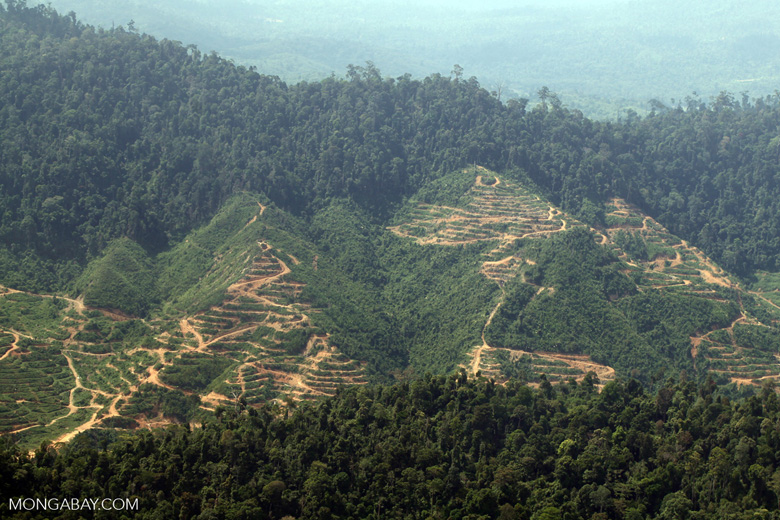
Forest
cleared for oil palm in Sabah, Malaysia. Note smoke plum on the edge of
the plantation. RSPO criteria ban open burning. Photo by Rhett A ButlerOfficials
say the program will better position Sabah as other states and regions
enter the palm oil business. Sabah accounts for 12 percent of global
palm oil production, but expects to see that share fall with rapid
plantation expansion in other parts of Asia, Latin America, and Africa.
“In
time to come, with increasing expansion of oil palm plantations in
other countries with suitable land to spare, Sabah’s share of the world
market will shrink. Further to that, on costs alone, Sabah might not be
able to compete and it is unlikely that Sabah will be in a position to
expand its land area for planting further, due to the scarcity of lands
and the marginal quality of whatever land is still available,” said the
declaration. “Hence, to remain competitive with its CPO and its oil palm
products salable economically, Sabah has to upgrade its position by
competing on the basis of governance and not size, which it is unable to
do.”
“Certified Sustainable Palm Oil as a brand for Sabah’s oil
palm, shall elevate its position as a producer of responsible oil palm.
This is what will keep us competitive,” the declaration continued. “The
current forest fires, allegedly caused by bad oil palm development
practices, must never be associated with Sabah’s oil palm.”
A forested hillside being cleared for oil palm in Sabah, Malaysia.While RSPO has not been without controversy, the body’s environmental criteria are generally stricter than national standards and are being strengthened due to pressure from environmentalists, rights groups, and consumer-facing companies concerned about being
associated with destructive and abusive practices. Photo by Rhett A.
ButlerThe plan puts Sabah on track
to become the first state to fully adopt certification for all of its
producers. Advocates say the so-called “jurisdictional approach” could
be an effective way to reduce risks in commodity supply chains by
creating “safe” markets for buyers while also cutting transactions costs
associated with certifying each individual plantation or farm. The
approach operates on the premise that producers in a jurisdiction would
pressure non-compliant peers to come into compliance for fear of losing
certification for the entire group. Monitoring would help ensure
producers are abiding by the rules, while higher margins from higher
prices and yields would provide them an additional incentive to
participate.
The certification program is a central component of
Forever Sabah, a multi-stakeholder initiative that endeavors to
transform Sabah’s economy.
“In Forever Sabah, we support a
circular economy that respects the interconnectedness of life and we see
this coming to fruition in future for the palm oil sector with Sabah’s
commitment on certification,” said Forever Sabah director Cynthia Ong in
a statement. “The jurisdictional level program is one that will put us
on the right track to collectively support livelihoods and protect the
environment. This jurisdictional approach could guarantee Sabah a key
place in global markets that, even before the haze, do not accept
business as usual in the palm oil sector.”
“The jurisdictional
level CSPO initiative will be supported with precision and scientific
agricultural practices to ensure yield can be increased with the same
amount of land,” Ong continued. “This includes guidance on conserving
insect population for pollination, recycling Palm Oil Mill Effluent
(POME) as fertilizer, replanting with high-yield and genetically
resilient plantlets, and community workshops to share latest best
practices.”
Forever Sabah envisions going well beyond the palm oil
sector, including establishing wildlife corridors, restoring forests
degraded by logging, and setting up new protected areas. The initiative
includes programs to foster polyculture and agroforestry,
community-based ecotourism, and more responsible stewardship of marine
resources.
Young
orangutan orphaned by the palm oil industry when its mother was killed
in a plantation in Central Kalimantan. This orangutan was one of the
lucky ones — it ended up in a rehabilitation center rather than dying of
starvation or being sold into the pet trade. Photo by Rhett A. Butler.Palm oil production has had a substantial impact in Sabah:roughly a fifth of the state's land mass has been converted to plantations,
including areas once covered by biologically-rich lowland forests that
house endangered orangutans, clouded leopards, and pygmy elephants.
However the state still retains significant blocks of healthy forest,
providing hope that curbing further destruction and restoring corridors
of habitat could help ensure a future for wildlife. Palm oil
Due
to its high yield which makes it a cheap source of vegetable oil, palm
oil is widely used as a cooking oil, a fat in processed foods like
cookies and crackers, and an ingredient in cosmetics and cleaning
products.
The world produced 54.3 million metric tons of palm oil
in 2013. Indonesia accounted for roughly half of that production, while
Malaysia came in about 35 percent. Human-wildlife
conflicts could potentially be reduced with the introduction of fully
certified palm oil for Sabah. Photo shows an elephant
Monday, 23 November 2015
ASEAN should aim to be haze free by 2018
Malaysia hopes ASEAN should aim to
be a haze free region by 2018, said Natural Resources and Environment Minister
Datuk Seri Dr Wan Junaidi Tuanku Jaafar said here today.
He said he had attended the 11th
Conference of Parties (COP) to the ASEAN Agreement on Transboundary Haze
Pollution held in Hanoi, Vietnam on Thursday and Friday where the haze problem
was the main issue.
Although this is not an official
declaration yet Malaysia expresses the hope that the ASEAN region should aim to
be haze free by then,” he told the media after launching the state annual
Environmental Week celebration here today.
Wan Junaidi said ASEAN countries
like Myanmar, Cambodia and Northern Thailand also suffered from the haze
because of their forest fires. “But the severity is less because they do not
have huge areas of peat soil.
“Malaysia, Singapore and Indonesia
are badly affected when most of the 1.7 million hectares under peat in
Indonesia catches fires,” he said. On Indonesia ‘s commitment to fight future
forest fires, Wan Junaidi said he had met with his Indonesian counterpart, Siti
Nurbaya Bakar recently.
“Indonesia will send a delegation to study our peat
soil management system in which we have drains and dams to help moisturise such
soil.
“They also want to learn about our
tube well system while we have a very strong enforcement by the Department of
Environment which they can learn from,” he added On the haze,
Wan
Junaidi said heavy rains, which occurred on October 17, had helped to douse
forest fires in Riau and Jampi and reduced the haze problem considerably.
Prime Minister Datuk
Seri Najib Razak, announcing this today, said both sides would appoint a
point person to ensure an immediate follow through
Malaysia hopes ASEAN
should aim to be a haze free region by 2018, said Natural Resources and
Environment Minister Datuk Seri Dr Wan Junaidi Tuanku Jaafar said here
today.
He said he had attended the 11th Conference of Parties (COP) to the
ASEAN Agreement on Transboundary Haze Pollution held in Hanoi, Vietnam
on Thursday and Friday where the haze problem was the main issue.
“Although this is not an official declaration yet Malaysia expresses the
hope that the ASEAN region should aim to be haze free by then,” he told
the media after launching the state annual Environmental Week
celebration here today.
Wan Junaidi said ASEAN countries like Myanmar, Cambodia and Northern
Thailand also suffered from the haze because of their forest fires.
“But the severity is less because they do not have huge areas of peat
soil.
“Malaysia, Singapore and Indonesia are badly affected when most of the
1.7 million hectares under peat in Indonesia catches fires,” he said.
On Indonesia ‘s commitment to fight future forest fires, Wan Junaidi
said he had met with his Indonesian counterpart, Siti Nurbaya Bakar
recently.
“Indonesia will send a delegation to study our peat soil management
system in which we have drains and dams to help moisturise such soil.
“They also want to learn about our tube well system while we have a very
strong enforcement by the Department of Environment which they can
learn from,” he added
On the haze, Wan Junaidi said heavy rains, which occurred on October 17,
had helped to douse forest fires in Riau and Jampi and reduced the haze
problem considerably.
PUTRAJAYA: India has
indicated its interest for a government-to-government cooperation in the
construction of a new convention centre in New Delhi.
Prime Minister Datuk Seri Najib Razak, announcing this today, said both
sides would appoint a point person to ensure an immediate follow
through.
"Indian Prime Minister Narendra Modi is a man of action and he wants
things to be done fast," Najib told reporters in a joint press
conference today.
A general view of a meeting between Malaysian delegates led by Prime
Minister Datuk Seri Najib Razak and Indian delegates led by India's
Prime Minister Narendra Modi at Putra Perdana in Putrajaya. Pix by
Aizuddin Saad
India also called on Malaysia to recognise the former's degrees in
Information Technology and engineering, he said, adding that the Higher
Education Ministry and Malaysia Quality Accreditation would act
immediately on this.
Najib said his Indian counterpart had presented to Malaysia "a lot of
exciting possibilities" for local companies and corporations to explore
in India.
"Modi has big plans to develop India in the construction of new
infrastructure including in railway development, highway development,
digital India, smart cities, solar energy and renewable energy."
Modi said India recognised Malaysia's ability in infrastructure
development.
The Indian prime minister also said he was keen to raise India's
participation in Malaysia's economy.
He added there were various areas that the two nations could explore
together including in defence and cyber-security.
Earlier, Malaysia and India signed three memorandum of understanding
(MoU) in performance management, project delivery and monitoring related
to government programmes and delivery; cultural exchange programme and
cyber security.
PUTRAJAYA: India has
indicated its interest for a government-to-government cooperation in the
construction of a new convention centre in New Delhi.
Prime Minister Datuk Seri Najib Razak, announcing this today, said both
sides would appoint a point person to ensure an immediate follow
through.
"Indian Prime Minister Narendra Modi is a man of action and he wants
things to be done fast," Najib told reporters in a joint press
conference today.
A general view of a meeting between Malaysian delegates led by Prime
Minister Datuk Seri Najib Razak and Indian delegates led by India's
Prime Minister Narendra Modi at Putra Perdana in Putrajaya. Pix by
Aizuddin Saad
India also called on Malaysia to recognise the former's degrees in
Information Technology and engineering, he said, adding that the Higher
Education Ministry and Malaysia Quality Accreditation would act
immediately on this.
Najib said his Indian counterpart had presented to Malaysia "a lot of
exciting possibilities" for local companies and corporations to explore
in India.
"Modi has big plans to develop India in the construction of new
infrastructure including in railway development, highway development,
digital India, smart cities, solar energy and renewable energy."
Modi said India recognised Malaysia's ability in infrastructure
development.
The Indian prime minister also said he was keen to raise India's
participation in Malaysia's economy.
He added there were various areas that the two nations could explore
together including in defence and cyber-security.
Earlier, Malaysia and India signed three memorandum of understanding
(MoU) in performance management, project delivery and monitoring related
to government programmes and delivery; cultural exchange programme and
cyber security.
Goods and Services Tax or GST is a consumption tax based on
value-added concept. Unlike the present sales tax or service tax which is a
single stage tax, GST is a multi-stage tax. Payment of tax is made in stages by
intermediaries in the production and distribution process. The tax itself is
not a cost to the intermediaries since they are able to claim back GST incurred
on their business inputs. GST is imposed on goods and services at every
production and distribution stage in the supply chain including importation of
goods and services.
GST is a tax charged on the supply (including sales) of
goods and services made in Malaysia and on the importation of goods and
services into Malaysia. Even though GST is charged on the sales price of the
goods or services, the amount to be remitted to the Government is only on the
value added to the goods or services at each level of the distribution/supply
chain.
The value added is the value that a producer (whether a manufacturer or
distributor, etc) adds to its raw material or purchases before selling the new
or improved product or service. To enable this, GST adopts a credit offset
mechanism whereby GST charged on the output of the business (for example, sale
of product manufactured or services supplied) is offset against the GST paid on
the goods or services acquired as inputs (for example, raw materials or
utilities to be used in manufacturing) by the business.
GST charged on output
is called output tax. Whereas, GST incurred on acquisition is called input tax.
This offsetting mechanism is to ensure GST paid by businesses is recoverable
and thus help to reduce the costs of doing business.
The Government had conducted social impact studies which
show that consumers will most likely bear some slight additional tax burden
depending on their consumption pattern and the rate of GST to be fixed. To ease
the increase in tax burden, tax and non-tax package may be given. However,
basic items such as rice, poultry, meat, vegetable, flour, cooking oil, sugar,
residential and agricultural properties, education and health services will not
be subjected to GST.
The first hurdle is that tax is not a popular
subject matter and generally nobody likes to be taxed or rather the word
"tax" is taboo to many. However, governments all over the world need
to impose tax in order to get the revenue to provide their citizens with their
social needs (infrastructure, health and education services), industrial growth
which results in employment opportunities, security, etc. People find it
difficult to accept the GST due to lack of knowledge on GST and how it benefits
them.
The second hurdle is the level of knowledge on
GST. It is not easy to educate consumers on GST as the moment you mentioned
that GST is a form of tax you will first be faced with a wall of resistance.
Thus, GST and its benefits have to be explained to them continuously in order
to avoid or eliminate whatever misconception or the wrong representation
provided to them regarding GST.
Towards this end, the Government has emphasized
that the racial have to understand GST before it is actually implemented.
Currently, people are also not aware that the GST will replace the current
sales tax and service tax. In fact, many people are not even aware that they
are paying sales tax and service tax on a lot of goods and services because of
its single stage nature.
Thursday, 19 November 2015
Oil Prices - Why Malaysia as Oil Producers in contrast to Arab countries
Let us compare the results of our country's oil output by another. Malaysia produces 623.900 barrels of oil per day, while Saudi Arabia produces 11.1 million barrels a day. Almost 17 times the product side. After rejecting the use of domestic fuel for both countries, is the result of overall exports to Malaysia 18,900 and 8,534,260 barrels of Saudi Arabia, once again, this huge gap. Of course with a greater profit, Saudi Arabia is able to decrease the price of oil to levels that are lower than ours.
State Oil Revenue Distribution
The oil our country is not used solely for fuel subsidies alone. It should be noted that the results of Petronas profits have accounted for 40% of the total national budget. In the state budget, the allocation given to the construction of new hospitals and the maintenance of existing hospitals, subsidies for vehicle fuel and cooking oil, sugar, schools, roads and others. Of course we can use all of the country's oil revenue to lower oil prices as equivalent to Arab countries. But are we willing to sacrifice their allocations for basic needs such as roads and schools?
Some say with confidence that the country's oil revenue only from crony. To my knowledge, most of the people who benefit from national budgets are civil servants who earn. Are, women and food traders cronies? Do doctors, teachers and civil servants cronies? Is our military who sacrifice their lives to defend the sovereignty of our country in Lahad Datu cronies?
Petronas profit increase. Why not use declines in oil prices?
Some may wonder why the Towers profit rose sharply, oil prices do not fall? First of all, for Petronas profits rose sharply beginning in 2008 is due to higher market prices for oil. The sharp increase in profit also experienced international oil companies such as Shell and Exxon Mobil. At the same time, contributions by Petronas on the national budget has been increased. A total of £ 67 billion has been contributed over £ 54 billion in 2007.
It should be noted that Petronas is the company and not all thankfully can be allocated to subsidies alone. As we all know, the country's oil resources will not last for long and may be exhausted by 2025 and therefore, the government has taken initiatives to reduce dependence on oil revenues. This is important so that we do not happen like Russia where oil company Gazprom, which when high oil prices to spend lavishly to buy a media company and so on. Immediately world market oil prices plummeted, Gazprom and the Russian financial crisis had economic challenges as far rely only on oil exports.
With the status of the United States that will soon become the world's largest oil producer, will make prices more stable world oil market and thus profit Petronas and other oil companies will not be at a high level as 2008. Of course that Malaysia can not be depending on the results of its own oil as a subsidy. If we spend beyond our means and Petronas for oil subsidy equivalent to Saudi Arabia, this will lead to problems in the future.
Tuesday, 17 November 2015
Haze
The choking haze which has persisted over Malaysia and Singapore for the past two months has so far cost the economies for both the counties hundreds of million of dollars. The total economic cost will take months to access and will have to cover all aspects of daily life, lost productivity and lost workdays through respiratory illness as well as higher prices for fresh food products.
Meanwhile the smoke from Indonesian forest fires permeates all walks of life on the Malay peninsula today. For example, school have close, flights are being cancelled and sea traffic through the Malacca Strait, one of the world's shipping lanes, has been delayed because of the poor visibility.